

You are using an out of date browser. It may not display this or other websites correctly.
You should upgrade or use an alternative browser.
You should upgrade or use an alternative browser.
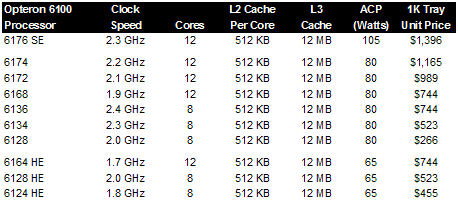
Socket G34, 12 cores @ 1.9 GHz or 8 cores at 2.4 GHz?
- Thread starter Pradeep
- Start date

Mercutio
Fatwah on Western Digital
Take that, Hyperthreading!
Actually, eight real cores for $266 is not outlandish, though it'll be interesting to see what each of those cores is actually capable of.
Actually, eight real cores for $266 is not outlandish, though it'll be interesting to see what each of those cores is actually capable of.
Pradeep
0
http://it.anandtech.com/IT/showdoc.aspx?i=3784
"AMD's 12-core "Magny-Cours" Opteron 6174 vs. Intel's 6-core Xeon"
"AMD's 12-core "Magny-Cours" Opteron 6174 vs. Intel's 6-core Xeon"
Mercutio
Fatwah on Western Digital
Seems like a draw overall, though I guess a draw is actually good news for AMD at this point.

Chewy509
Wotty wot wot.
It might be interesting in seeing a 6136 vs 6168 review.
On one hand you have 8 cores @ 2.4Ghz w/12MB shared cache, and on the other hand 12 cores @ 1.9Ghz w/12MB cache. While the 12core 6168 has a higher theoretical GHz count (22.8GHz vs 19.2GHz), each core on the 8core 6136 runs faster and has more L3 cache per core on the CPU.
Yet both are the same price?
(For those that haven't read any reviews, the "Magney-Cours" uses the same core design as the current Instanbul CPU, so per core performance is the same).

Mercutio
Fatwah on Western Digital
4 cores at 5GHz can't be economically manufactured and you know it.

I'd rather have 4 cores at 5GHz. Presumably there is no market.
I would, too. But Merc is right; physics and all that. Hell, I would love a single 10GHz CPU.
Chewy509
Wotty wot wot.
I would, too. But Merc is right; physics and all that. Hell, I would love a single 10GHz CPU.
Easy, find a Pentium4 EE (netburst). Overclock to 5GHz (using LN2), and you have a CPU whose ALUs are running at 10GHz...
PS. For those that don't know, the ALUs on a Netburst based P4, ran at 2x the advertised clock speed.

CougTek
Hairy Aussie
IBM's Power 7 processor operates at 4.14GHz. Is that close enough?
RISC doesn't count 
Pradeep
0
IBM's Power 7 processor operates at 4.14GHz. Is that close enough?
Well Merc did say "economically"
Power 7 at 4.14GHz is limited to 4 cores:
ftp://public.dhe.ibm.com/common/ssi/pm/sp/n/pod03032usen/POD03032USEN.PDF
Less than 7 figures, more than 5.
Still, like they say. If you have to have your business stay up 24*7, treat it to an IBM.
Mercutio
Fatwah on Western Digital
Does anyone know how to pronounce Mangy-Cours?
I'm assuming it's something like "Man-yee Coors" but francophones are sticklers for pronunciation.
I figure Coug will know.
I'm assuming it's something like "Man-yee Coors" but francophones are sticklers for pronunciation.
I figure Coug will know.
Mercutio
Fatwah on Western Digital
Mahn-yee Coors?
Pradeep
0
I say Mag-nee Coors.
I've been thinking "Mangy Coors" kind of like "Mangy Dog", but with beer.
jtr1962
0
Until we're able to commercially produce light-based CPUs ~3.5 to 4 GHz is about as fast as we're going to be able to go. There are inherent limits on clock speed due to things like trace capacitance/inductance. You really can't economically get around these limits. This is why we started adding cores in the first place instead of increasing clock speeds. CPUs based on light will have none of these limitations, but they're decades away.

udaman
0
- Joined
- Sep 20, 2006
- Messages
- 1,209
Until we're able to commercially produce light-based CPUs ~3.5 to 4 GHz is about as fast as we're going to be able to go. There are inherent limits on clock speed due to things like trace capacitance/inductance. You really can't economically get around these limits. This is why we started adding cores in the first place instead of increasing clock speeds. CPUs based on light will have none of these limitations, but they're decades away.
Not at present, no...but who knows in the near term future? Just like we're stuck around $1/watt solar panels, in 5-10 could possibly be 1/10th the cost!
Revolutionary New Solution for Semiconductor, Nano Materials
Pradeep
0
Until we're able to commercially produce light-based CPUs ~3.5 to 4 GHz is about as fast as we're going to be able to go. There are inherent limits on clock speed due to things like trace capacitance/inductance. You really can't economically get around these limits. This is why we started adding cores in the first place instead of increasing clock speeds. CPUs based on light will have none of these limitations, but they're decades away.
Actually the Power 7 uses optical interconnects for certain pathways:
http://www.theregister.co.uk/2009/11/27/ibm_power7_hpc_server/print.html

sechs
0
http://tinyurl.com/yermngwDoes anyone know how to pronounce Mangy-Cours?
CougTek
Hairy Aussie
The "s" is silent. Mahn-yee-coor is about as close as an english-speaking person can pronounce it right. If you trully want to ear it, I can try to find a microphone and send you the wave file. There's a French F1 race track that has that name too.Mahn-yee Coors?
Mercutio
Fatwah on Western Digital
If you actually look at those links, you'll see that there are multiple phonetic pronunciations, probably from other dumbshits who don't have any idea either.
They aren't French, they are based in Sunnyvale, CA.
Everybody is using place names as dev names so they can't be copyrighted.
Everybody is using place names as dev names so they can't be copyrighted.
They aren't French, they are based in Sunnyvale, CA.
Everybody is using place names as dev names so they can't be copyrighted.
What do you mean can't be copyrighted as dev names?
The name of a place (a city, river, mountain range) can't be copyrighted, so they use them as dev names to save money on legal filings.
udaman
0
- Joined
- Sep 20, 2006
- Messages
- 1,209
The name of a place (a city, river, mountain range) can't be copyrighted, so they use them as dev names to save money on legal filings.
name of a place can be trademarked, depending on the product/situation:
http://www.law.uconn.edu/homes/swilf/ip/cases/in_re_nantucket.htm
The name of a place (a city, river, mountain range) can't be copyrighted, so they use them as dev names to save money on legal filings.
What is "dev?" Development, developer, developing?
development, a product code-name.
sechs
0
You'd be surprised to learn that Intel is based in Oregon.For some reason I never realized that AMD was French. I assumed that they were a US or Taiwanese company.
Microsoft is a ski lodge.
You'd be surprised to learn that Intel is based in Oregon.
Why is that surprising?

They haven't really written much since 2000, have they;-)
David: You REALLY need to get into water cooling...
Who has not written much what?
Pradeep
0
Water cooling is certainly a better option when dealing with cards in the power range of the 5970. Let's you take that heat plus the CPU(s) and disperse it into a radiator cooled with slow running 120mm or larger fans. Benefits are far lower noise levels and higher overclocking headroom. Downside is additional cost of cooling system plus extra for waterblocked video cards, and possible total burnout if one of those couplings isn't secure. GFCI outlets would be good. I believe some of the latest water cooling kits have enough intelligence to shutdown the PC if it senses an overtemp situation.
Water cooling is certainly a better option when dealing with cards in the power range of the 5970. Let's you take that heat plus the CPU(s) and disperse it into a radiator cooled with slow running 120mm or larger fans. Benefits are far lower noise levels and higher overclocking headroom. Downside is additional cost of cooling system plus extra for waterblocked video cards, and possible total burnout if one of those couplings isn't secure. GFCI outlets would be good. I believe some of the latest water cooling kits have enough intelligence to shutdown the PC if it senses an overtemp situation.
Indeed. I'm hoping that one of the vendors releasing a 5970 E6 will have factory waterblocks on it. My motherboard already does, and I can get a CPU waterblock when I switch to the i7-980X
sechs
0
BECAUSE IT'S NOT TRUE.Why is that surprising?
On the other hand, Microsoft really is a ski lodge in the Canadian Rockies.
BECAUSE IT'S NOT TRUE.
On the other hand, Microsoft really is a ski lodge in the Canadian Rockies.
I would not know the difference. I assume MS owns many facilities.

mubs
0
Intel DID have a facility in Oregon where the Willamette (P4) was designed. I know because my cousin worked for them there. He left them in 2001 or 2002, and I don't know if they still have that facility.BECAUSE IT'S NOT TRUE.
On the other hand, Microsoft really is a ski lodge in the Canadian Rockies.
sechs
0
Nonetheless, their headquarters are still in Santa Clara. Unlike the Microsoft ski lodge in British Columbia, I've been there.Intel DID have a facility in Oregon